This article is (c)2023 Midwest Rail Rangers, a 501(c)(3) non-profit historical organization.
The first Zephyr service to Denver began May 31, 1936, with the trainsets of the Pioneer Zephyr and the Mark Twain Zephyr, trains 9900 and 9903. This new service was known as the Advance Denver Zephyr and operated on a 16-hour schedule. The trains did not have sleepers, but introduced hostesses called
"Zephyrettes".
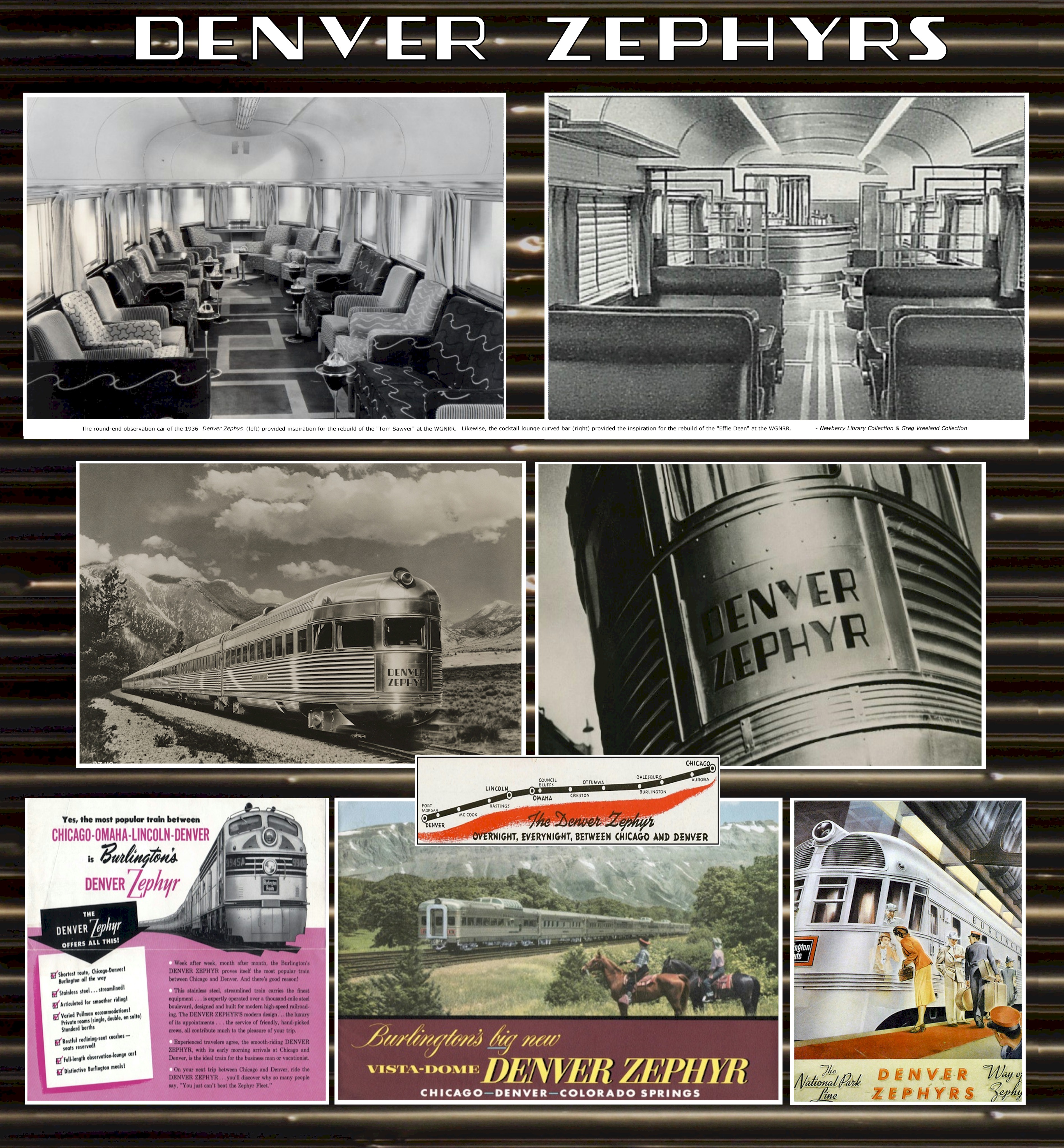
In the meantime, after the success of the 3-car and 4-car Pioneer Zephyr, Twin Zephyrs, and Mark Twain Zephyrs, the Burlington had ordered two pairs of longer stainless steel streamliners from the Budd Company. One pair was fully articulated 6-car trainsets used to replace the 3-car Twin Cities Zephyrs. The other pair were 10-car trainsets, partly articulated, which became the Chicago-Denver Denver Zephyr. Accommodations on these trains included coaches, sections, single and double rooms, and dining and lounge facilities. The observation cars carried parlor seats for local travel.
On October 23, 1936, one of the new ten-car trainsets made a special run nonstop Chicago to Denver in an effort to break the 1934 record of the Pioneer Zephyr between the two cities. The train went from Chicago to Denver in 12 hours, 12 minutes, and 27 seconds, at start-to-stop average of 83.89 miles per hour and reached 116 miles per hour between Akron and Brush in Colorado. Distance was given as 1,017.22 miles via Plattsmouth direct to Lincoln, Nebraska, bypassing Omaha on the regular route of the train. The new trainsets went into regular service 16 days later, November 8, 1936, replacing the trainsets used on the route since May.
Power for the new trainsets came from the General Motors' Electro-Motive Division. Each was led by a twin-engine forerunner to the E series featuring two Winton V-12 201-A diesels of 900 horsepower each, articulated to a booster with one V-16 of 1,200 horsepower for a total rating of 3000. These were bodied by Budd in shotwelded stainless steel, and designated 9906A/B "Silver King and Silver Queen" and 9907A/B "Silver Knight/Silver Princess".
The train ran 1,034 miles between Denver and Chicago overnight in 16 to 16.5 hours. Within two years a dinette coach and an all-room sleeper were added.
The trainsets were refurbished in the winter of 1948-49 and operated in Denver Zephyr service until October 1956 when they were reassigned to the Denver-Fort Worth/Dallas Texas Zephyr route on Burlington subsidiaries Colorado and Southern and Fort Worth and Denver Railways. .
Around 1953 Union Pacific began reequipping its competing City of Denver. In addition, the Burlington, Denver and Rio Grande Western, and Western Pacific Railroads had replaced their heavyweight Chicago-Oakland Exposition Flyer with a new streamlined California Zephyr carrying Vista-domes in 1949. Both of these trains took passengers from the Denver Zephyr, but ridership remained respectable. But the train's consist -- semi-articulated with a unique braking, steam connection system that was incompatible with other standard equipment -- meant that cars could not be added to the train proper, but had to be added ahead of the baggage car or as a separate section. These cars needed their own food service, compromising the economics of adding the additional cars. The Burlington decided in 1955 to reequip the train with more conventional non-articulated equipment. Thus was conceived the last complete streamlined train to be built for a private railroad in the United States.
The new stainless steel train, also built by the Budd Company, offered all room sleeping accommodations and, in addition to a full diner, offered a Vista-dome coffee shop car called the Chuckwagon. Parlor seats continued to be available in the observation car. Because of the popularity of the Denver-Chicago segment of the Vista-dome California Zephyr, the new train also carried Vista-Domes. In addition, a new all room sleeping accommodation, the slumbercoach, offered private sleeping facilities, with in-room washstand and toilet, to passengers at coach fares plus a small surcharge. These cars were revolutionary in their use of fiberglass room modules. Each train carried two and they always were sold out, even up to the beginning of Amtrak. By 1959 slumbercoaches would appear on the trains of four other railroads, although three would later give them up. Between 1959 and late 1964, CB&Q's four cars and Northern Pacific Railway's four cars were pooled in Denver Zephyr / North Coast Limited service. The pool required tight scheduling and good timekeeping and was discontinued when Northern Pacific acquired eight additional slumbercoaches second-hand. Even though only 18 of these revolutionary cars were built new, they remained popular, even after operation of rail passenger service was assumed by Amtrak, and carried passengers until the mid-1990s, when age and changes in passenger car requirements forced their retirement.
================================================
ZephyrHistory.com and NebraskaZephyr.com are maintained by the Midwest Rail Rangers. If you enjoyed the content, please consider making a donation to our 501(c)(3) non-profit rail history organization. For more information, you can e-mail us at board@railrangers.org.
No part of the materials available at www.ZephyrHistory.com and NebraskaZephyr.com may be copied, photocopied, reproduced, translated or reduced to any electronic medium or machine-readable form, in whole or in part, without prior written consent of: Midwest Rail Rangers Corporation / P.O. Box 184 / Barron, WI 54812 / info@railrangers.org
and are available for purchase at www.RailFonts.com.